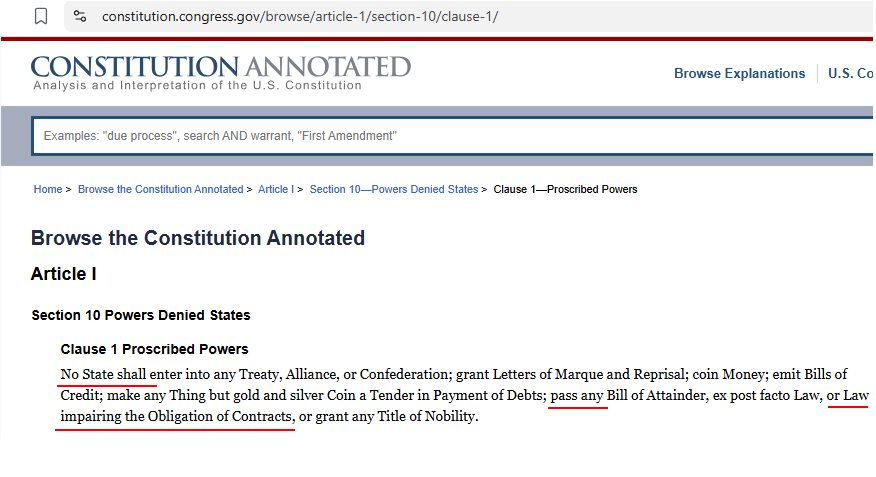
Article 1, Section 10, Clause 1 - No State Shall Impair the Obligation of Contracts
This allows people to step outside the Constitutional Contract and contract independently, giving all their rights away, if they choose to.
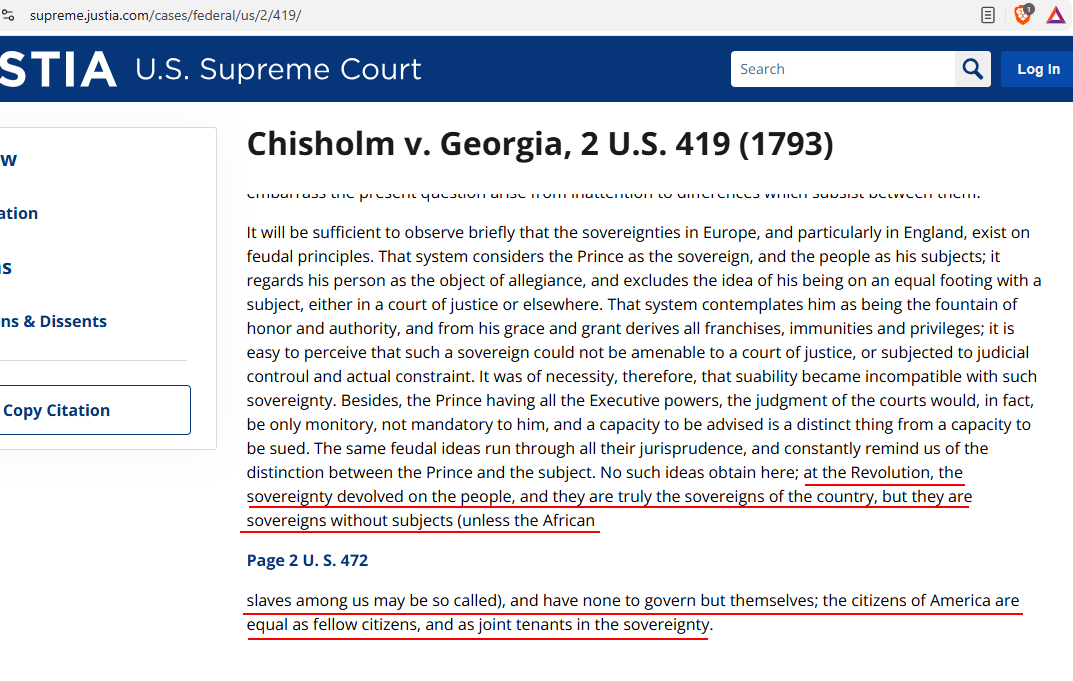
Chisholm v. Georgia, 2 U.S. 419 (1793)
“…at the Revolution, the sovereignty devolved on the people; and they are truly the sovereigns of the country, but they are sovereigns without subjects…with none to govern but themselves; the citizens of America are equal as fellow citizens, and as joint tenants in the sovereignty.” — 2 U.S. at 456.
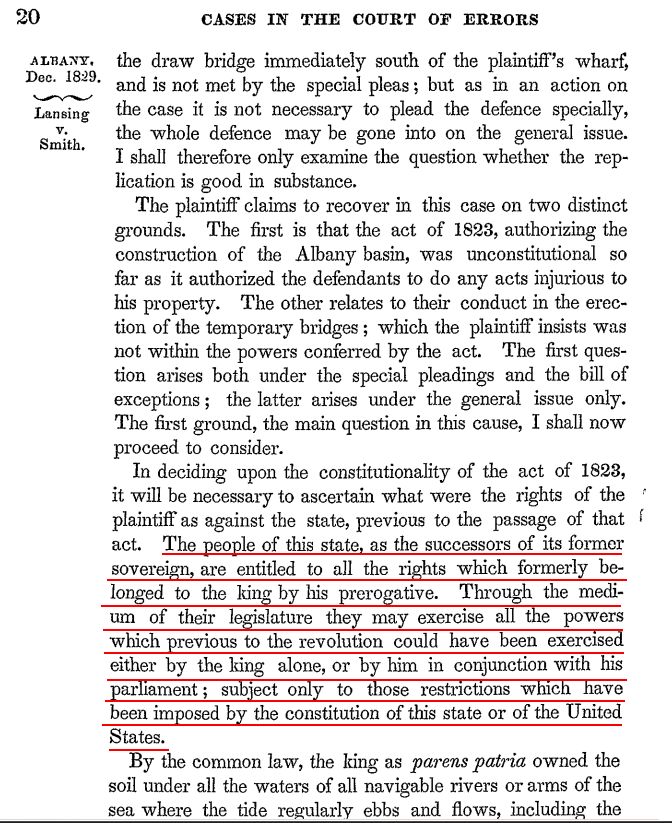
Lansing v. Smith, 21 Wendell 9 (N.Y. 1829)
Sovereignty Resides in the People
“The people of this State, as the successors of its former sovereign, are entitled to all the rights which formerly belonged to the King by his prerogative. Through the medium of their Legislature they may exercise all the powers which previous to the Revolution could have been exercised either by the King alone, or by him in conjunction with his Parliament; subject only to those restrictions which have been imposed by the Constitution of this State or of the U.S.”
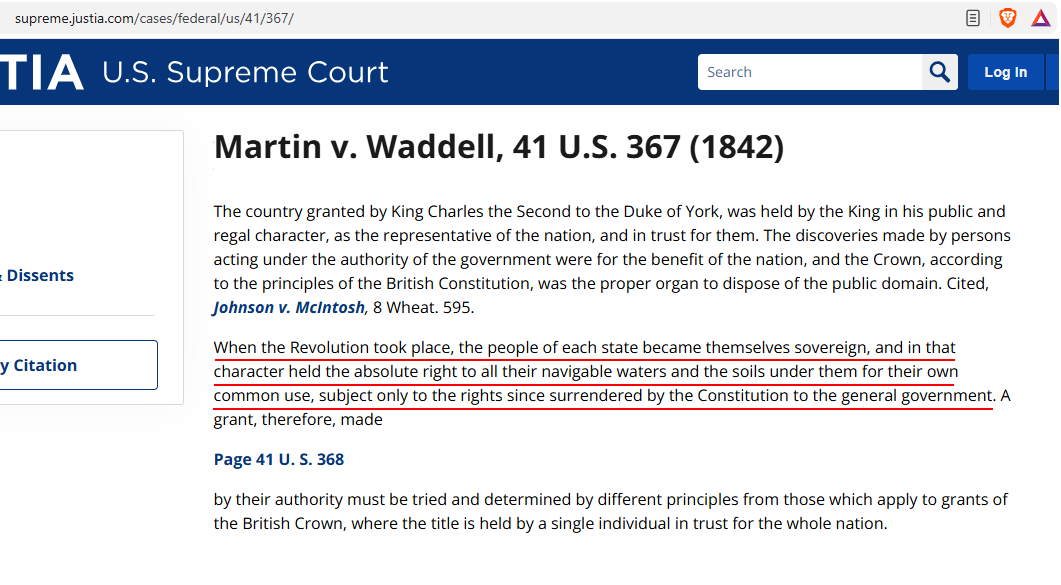
Martin v. Waddell, 41 U.S. (16 Pet.) 367 (1842)
“For when the [American] Revolution took place, the people of each state became themselves sovereign; and in that character hold the absolute right to all their navigable waters, and the soils under them, for their own common use, subject only to the rights since surrendered by the Constitution to the general government.” — 41 U.S. at 410
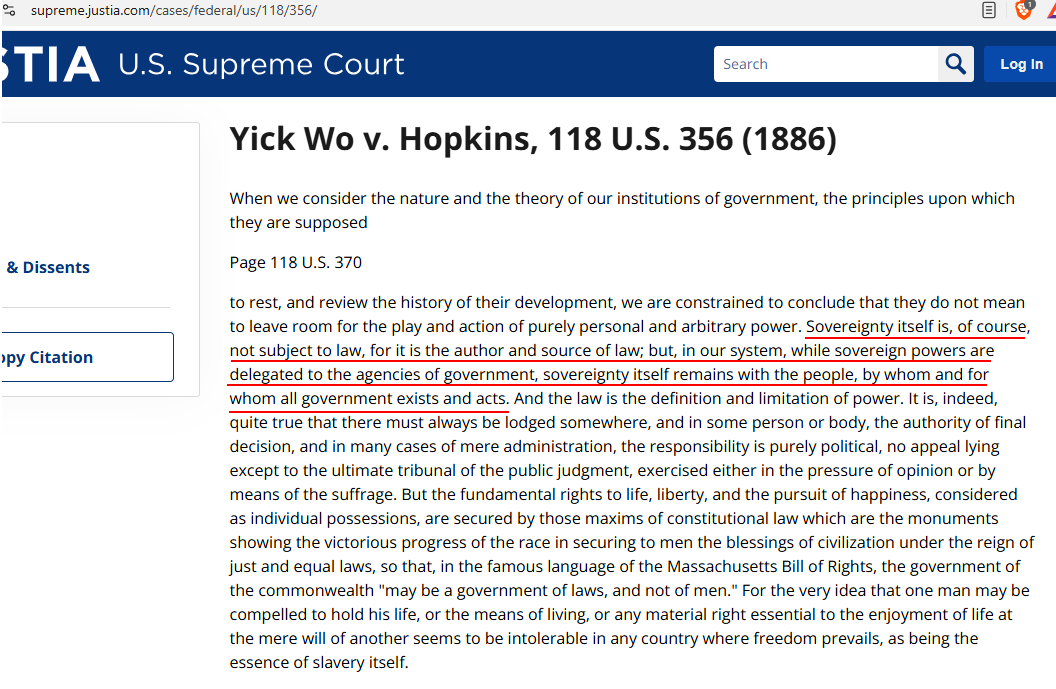
Yick Wo v. Hopkins, 118 U.S. 356 (1886)
“Sovereignty itself is, of course, not subject to law, for it is the author and source of law; but in our system, while sovereign powers are delegated to the agencies of government, sovereignty itself remains with the people, by whom and for whom all government exists and acts.” — 118 U.S. at 370.
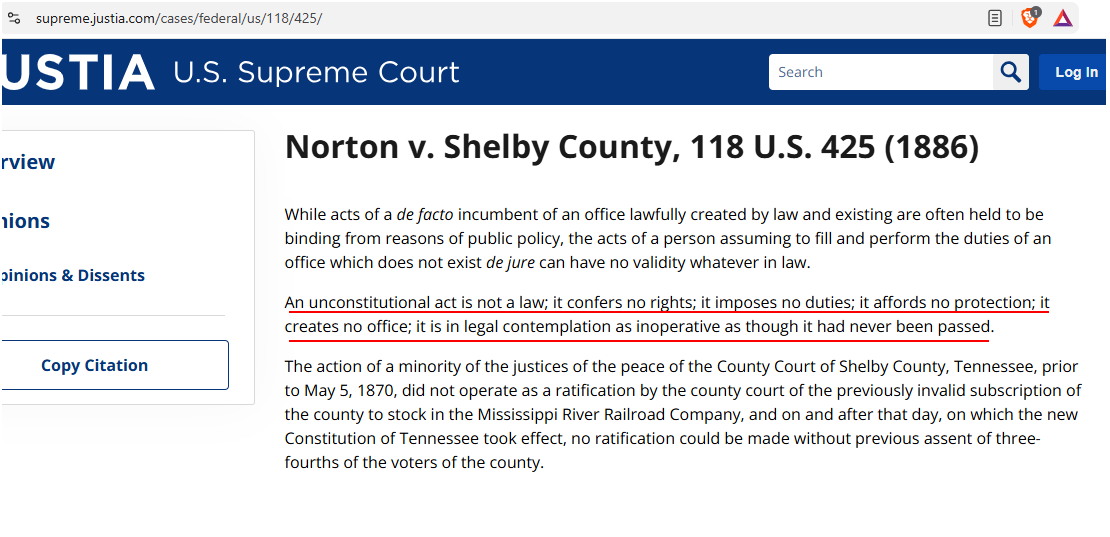
Norton v. Shelby County, 118 U.S. 425 (1886)
“An unconstitutional act is not a law; it confers no rights; it imposes no duties; it affords no protection; it creates no office; it is in legal contemplation as inoperative as though it had never been passed.”
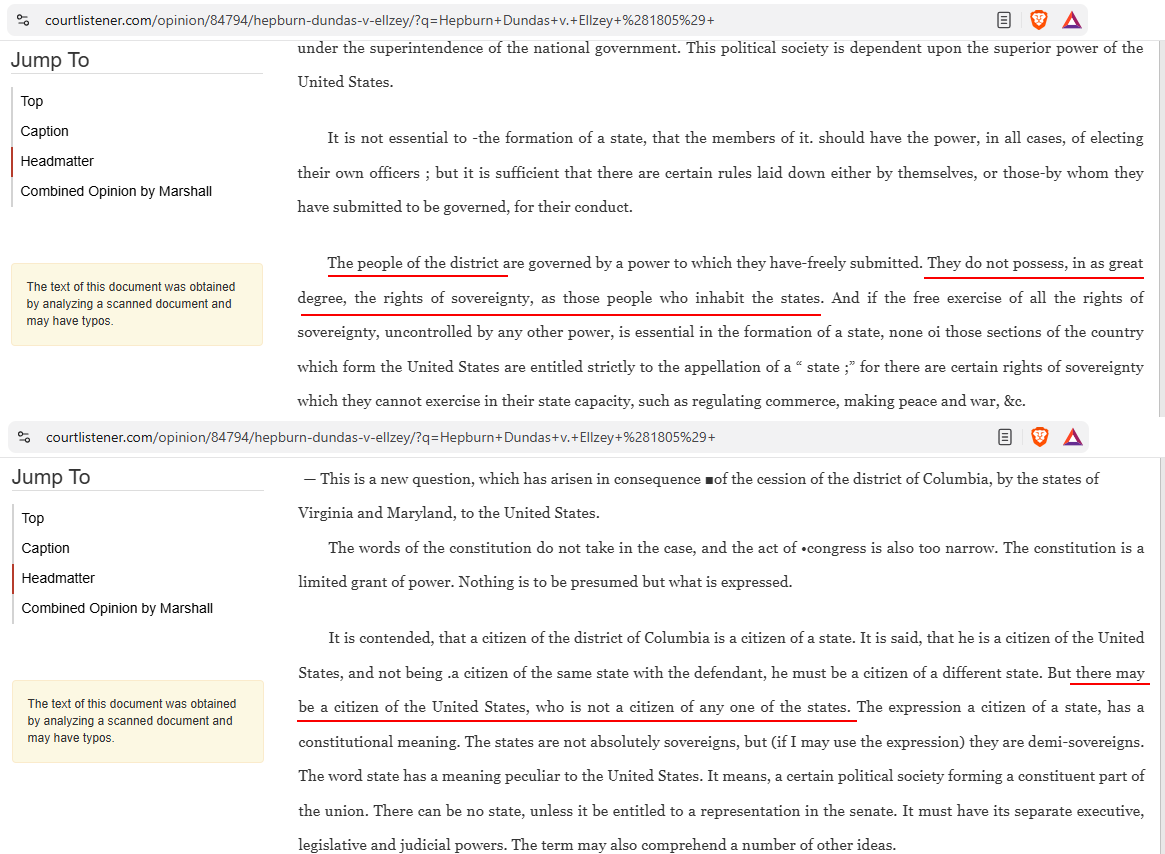
Hepburn & Dundas v. Ellzey (1805)
“The people of the district are governed by a power to which they have-freely submitted. They do not possess, in as great degree, the rights of sovereignty, as those people who inhabit the states.” – “But there may be a citizen of the United States, who is not a citizen of any one of the states. ” – (Showing that as early as 1805, there were citizens of the Territories, considered at that time the United States, who did NOT possess equal rights as the citizens of the states) – They were called “citizens of Columbia”
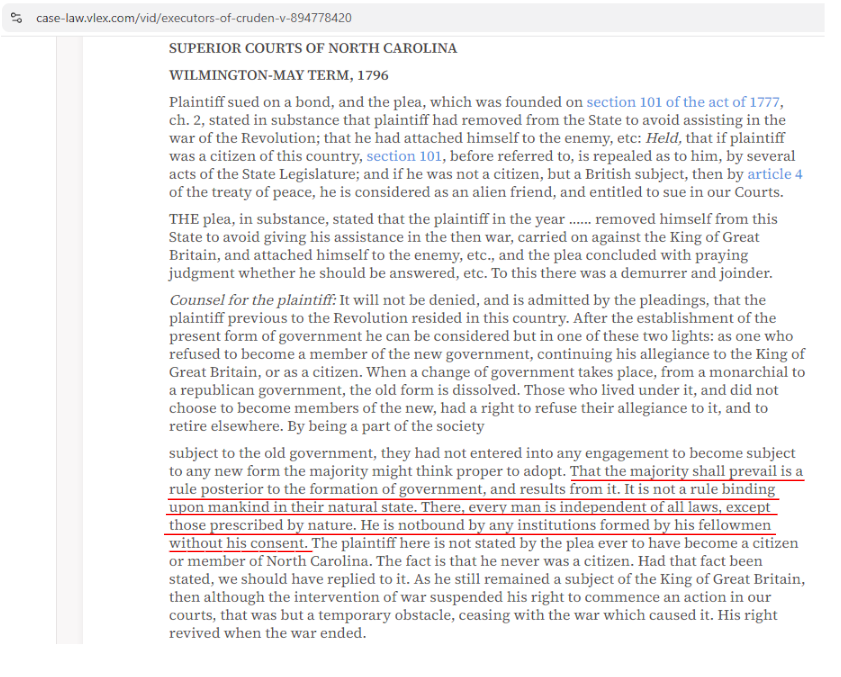
Cruden v. Neale (1796)
“That the majority shall prevail is a rule posterior to the formation of government, and results from it. It is not a rule binding upon mankind in their natural state. There, every man is independent of all laws, except those prescribed by nature. He is not bound by any institutions formed by his fellowmen without his consent”
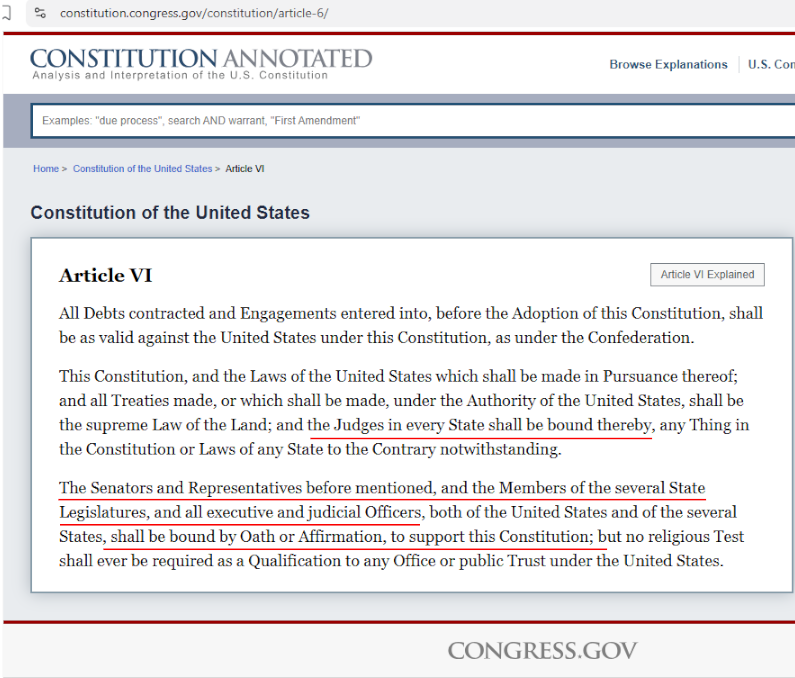
Article VI Section 2 & 3 - Who is Bound?
“and the judges, in every state, shall be bound thereby, anything in the constitution or laws of any state to the contrary notwithstanding. 3. The senators and representatives before mentioned, and the members of the several state legislatures, and all executive and judicial officers, both of the united states and of the several states shall be bound, by oath or affirmation to support this constitution”
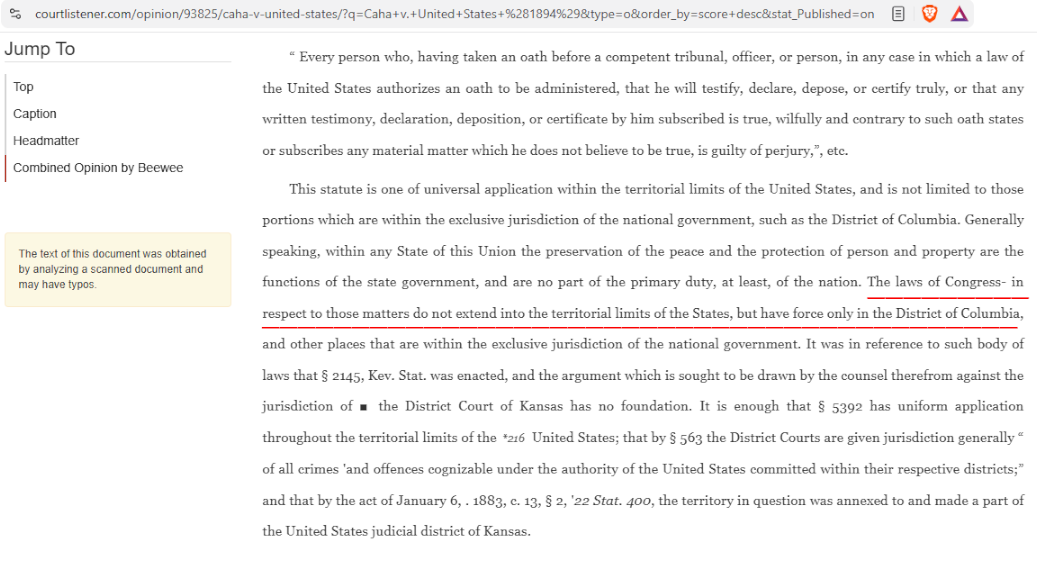
Caha v. United States, 152 U.S. 211 (1894)
“The laws of Congress in respect to those matters do not extend into the territorial limits of the states, but have force only in the District of Columbia and other places that are within the exclusive jurisdiction of the national government.”
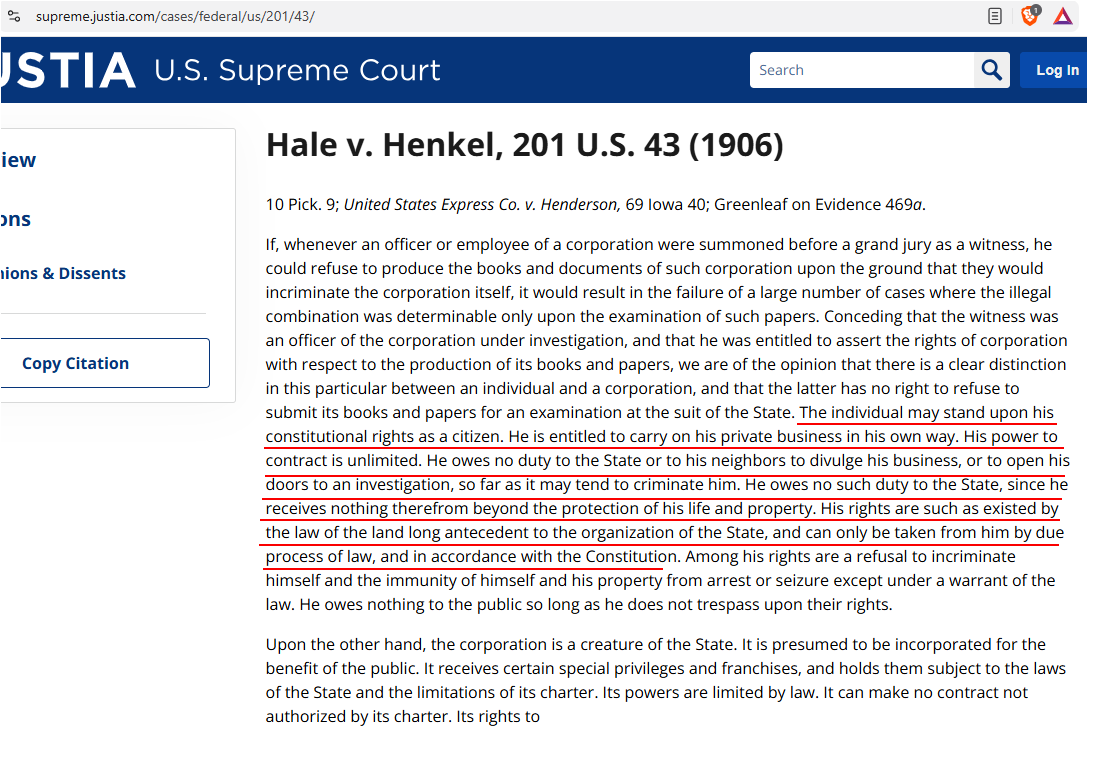
Hale v. Henkel (March 12, 1906)
“The individual may stand upon his constitutional rights as a citizen. He is entitled to carry on his private business in his own way. His power to contract is unlimited. He owes no duty to the state or his neighbors to divulge his business, or to open his door to an investigation, so far as it may tend to incriminate him. He owes no such duty to the state, since he receives nothing there from, beyond the protection of his life and property. His rights are such that existed by the law of the land long antecedent to the organization of the State….. He owes nothing to the public so long as he does not trespass on their rights.”
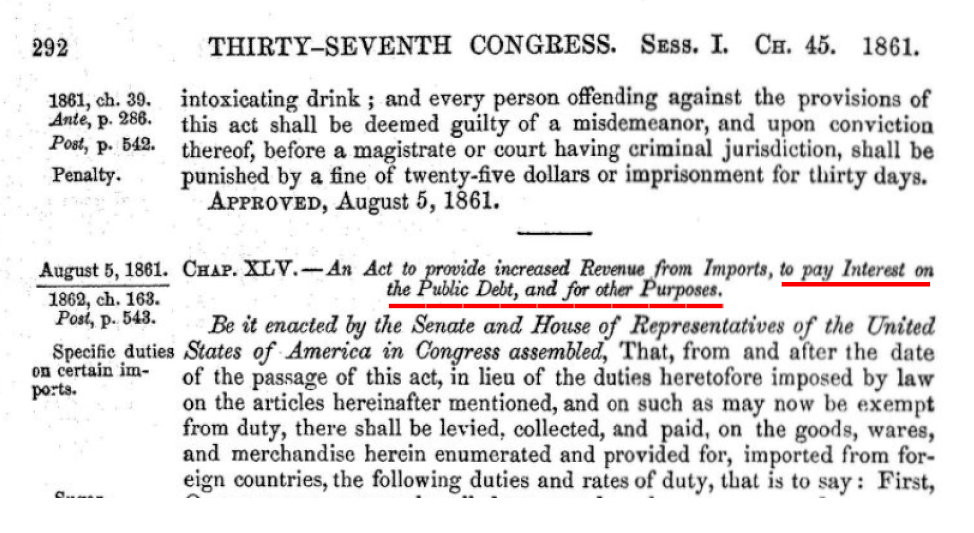
The Revenue Act of 1861 (Ch. 45, 12 Stat. 292)
“An Act to provide increased Revenue from Imports, to pay Interest on the Public Debt, and for other Purposes.”
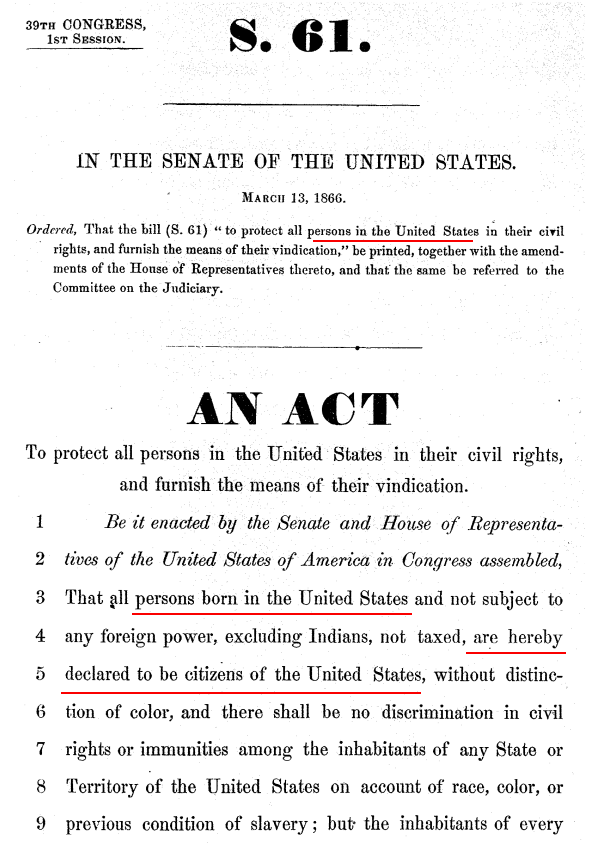
Civil Rights Act of 1866
“all persons born in the United States and not subject to any foreign power, excluding Indians, not taxed, are hereby declared to be citizens of the United States”
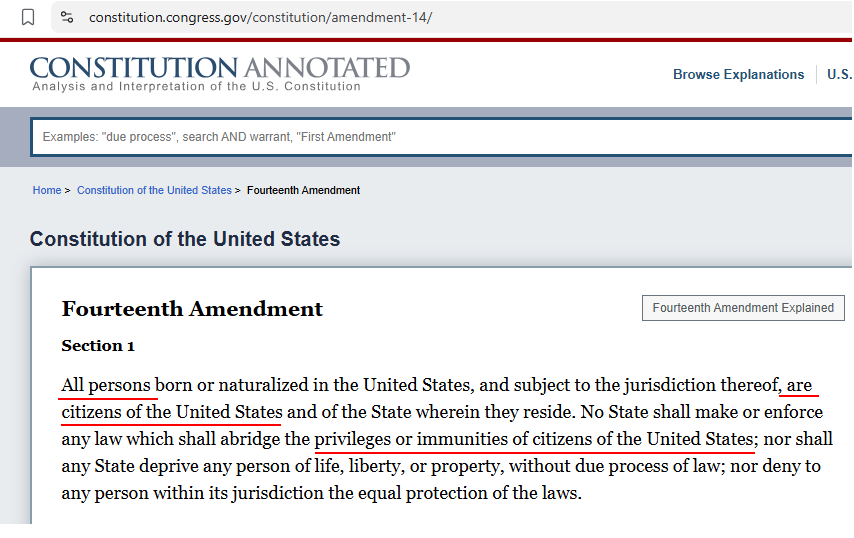
14th Amendment, Section 1
“All persons … are citizens of the United States….. No State shall make or enforce any law which shall abridge the privileges or immunities of citizens of the United States;”
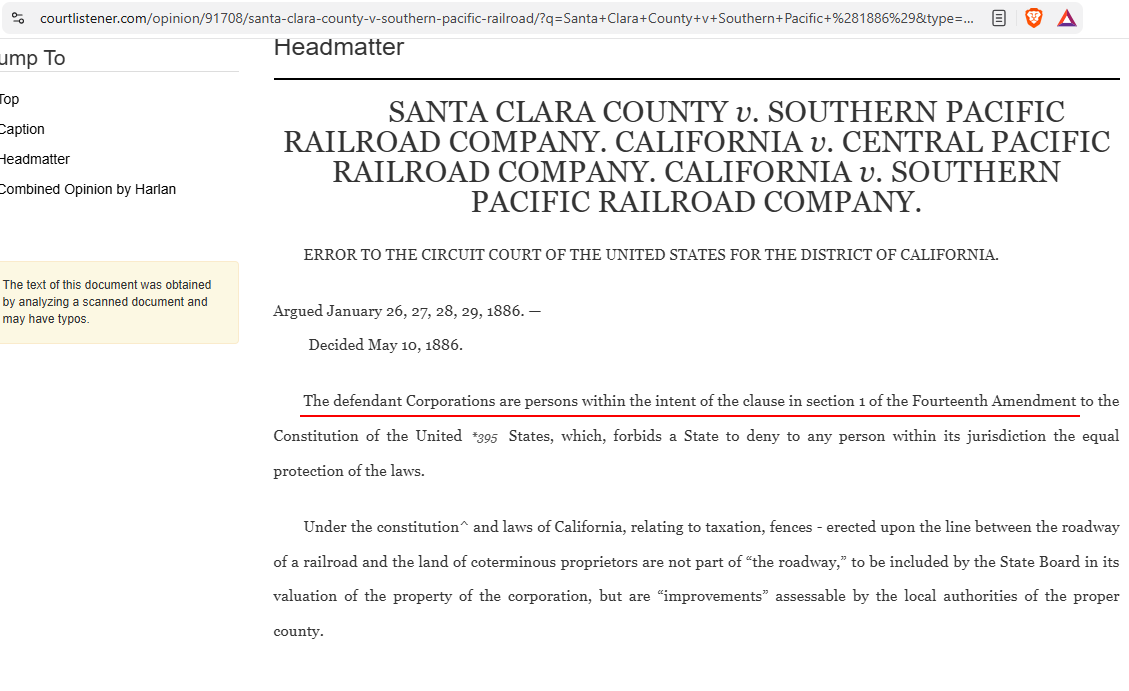
Santa Clara County v Southern Pacific (1886)
“The defendant Corporations are persons within the intent of the clause in section 1 of the Fourteenth Amendment to the Constitution”
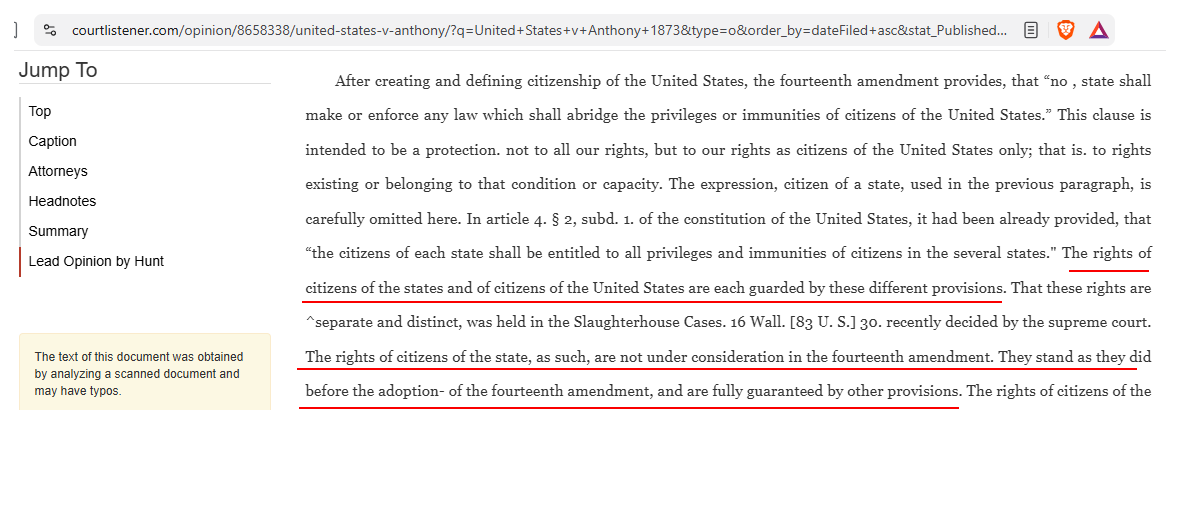
United States v Anthony (1873)
“The rights of citizens of the states and of citizens of the United States are each guarded by these different provisions. …. The rights of citizens of the state, as such, are not under consideration in the fourteenth amendment. They stand as they did before the adoption- of the fourteenth amendment, and are fully guaranteed by other provisions. “
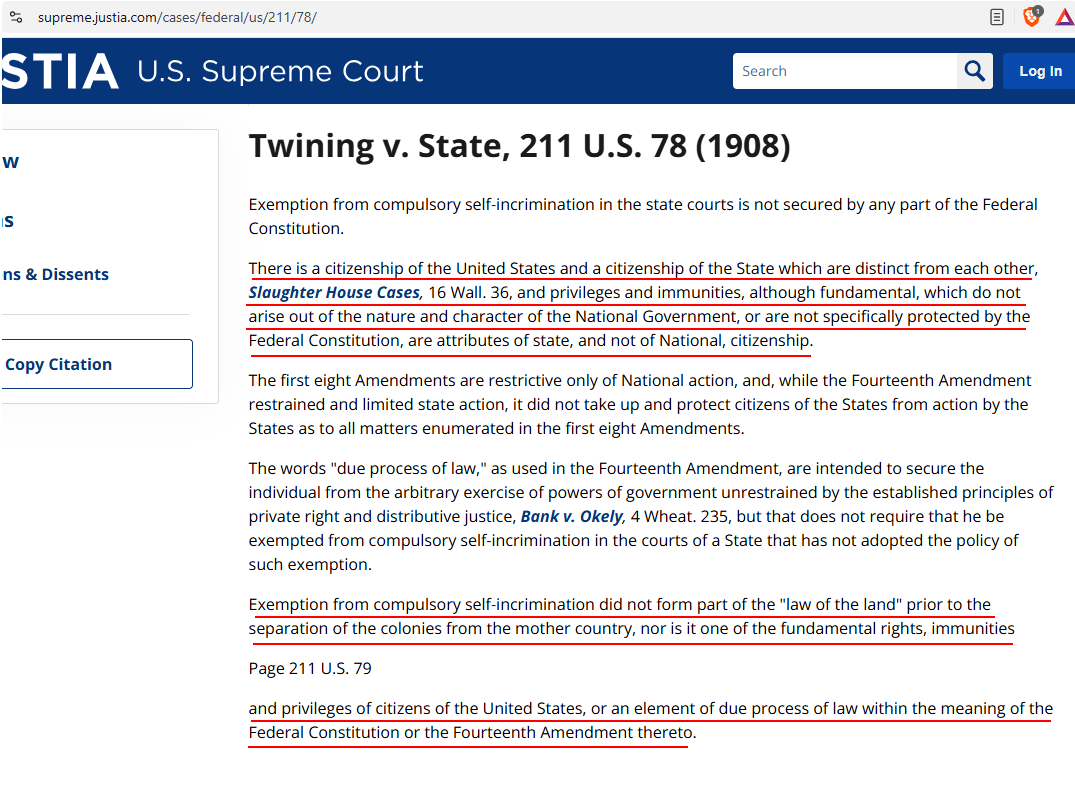
Twining v. New Jersey (1908) Pt 1
“If then it be assumed, without deciding the point, that an exemption from compulsory self-incrimination is what is described as a fundamental right belonging to all who live under a free government, and incapable of impairment by legislation or judicial decision, it is, so far as the States are concerned, a fundamental right inherent in state citizenship, and is a privilege or immunity of that citizenship only. Privileges and immunities of citizens of the United States, Crosse v. Board of Supervisorson the other hand, are only such as arise out of the nature and essential character of the National Government, or are specifically granted or secured to all citizens or persons by the Constitution of the United States.”
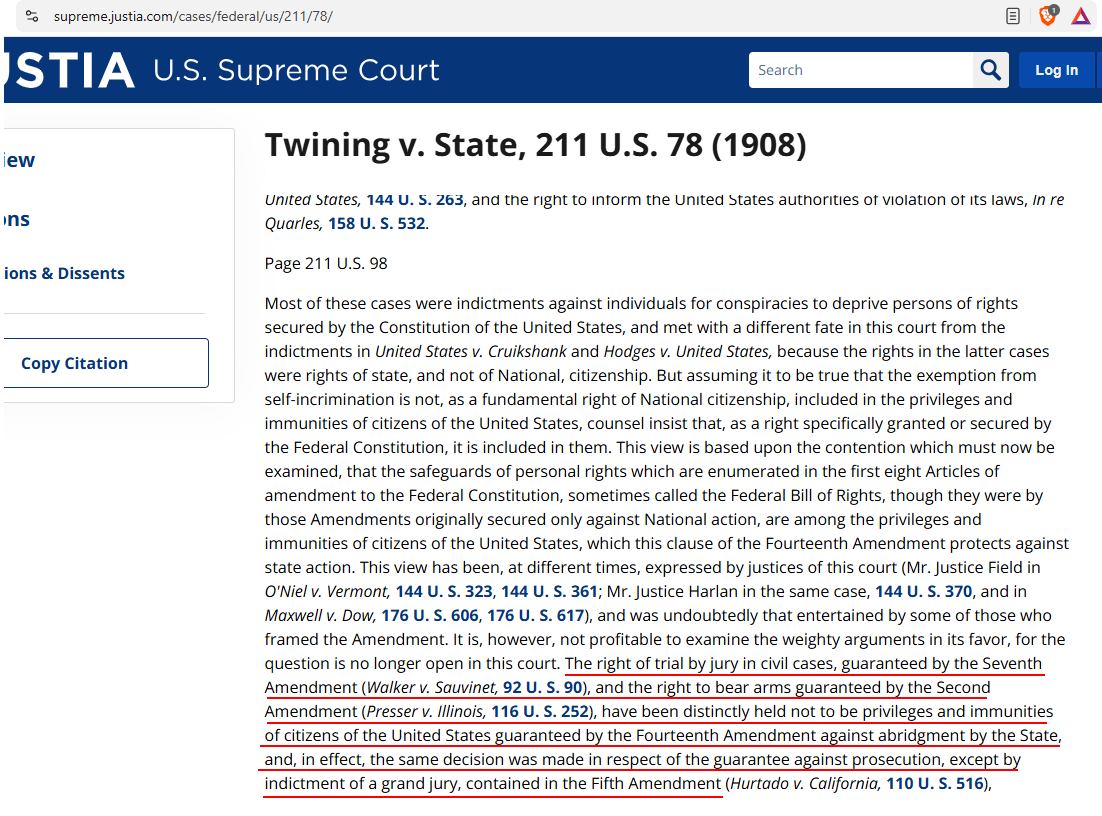
Twining v. New Jersey (1908) Pt 2
” The right of trial by jury in civil cases, guaranteed by the Seventh Amendment and the right to bear arms guaranteed by the Second Amendment have been distinctly held not to be privileges and immunities of citizens of the United States guaranteed by the Fourteenth Amendment against abridgment by the State, and, in effect, the same decision was made in respect of the guarantee against prosecution, except by indictment of a grand jury, contained in the Fifth Amendment”
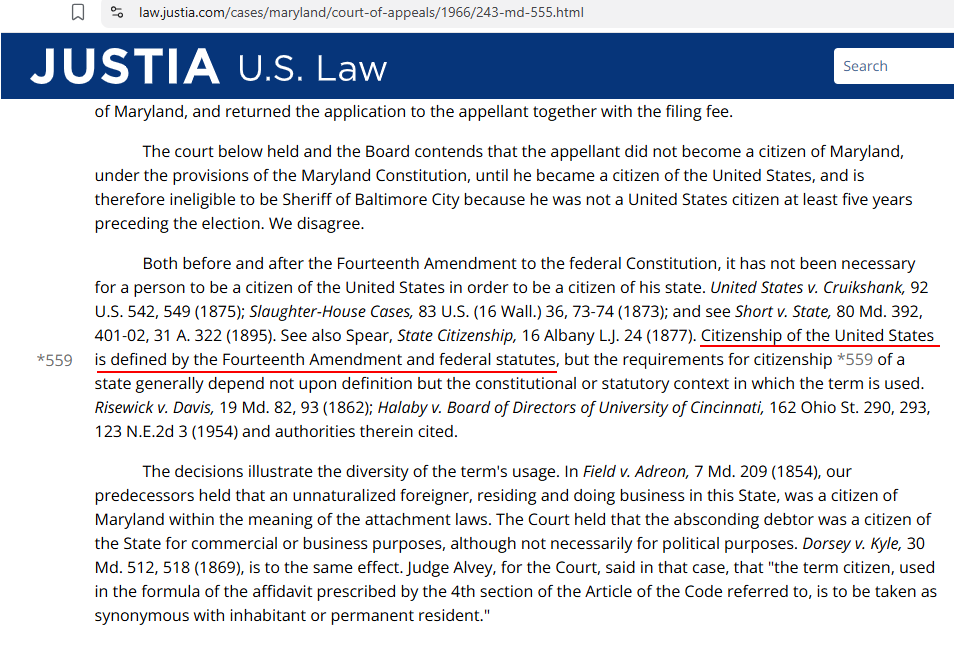
Crosse v. Board of Supervisors of Elections of Baltimore City (1966)
“Citizenship of the United States is defined by the Fourteenth Amendment and federal statutes”
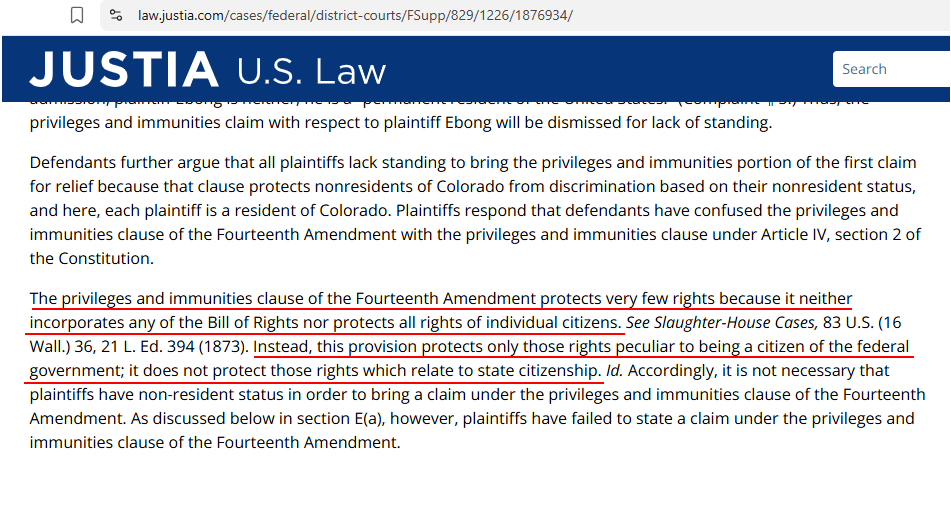
Jones v. Temmer, 829 F. Supp. 1226 (D. Colo. 1993)
“The privileges and immunities clause of the Fourteenth Amendment protects very few rights because it neither incorporates any of the Bill of Rights nor protects all rights of individual citizens. See Slaughter-House Cases, 83 U.S. (16 Wall.) 36, 21 L. Ed. 394 (1873). Instead, this provision protects only those rights peculiar to being a citizen of the federal government; it does not protect those rights which relate to state citizenship.”
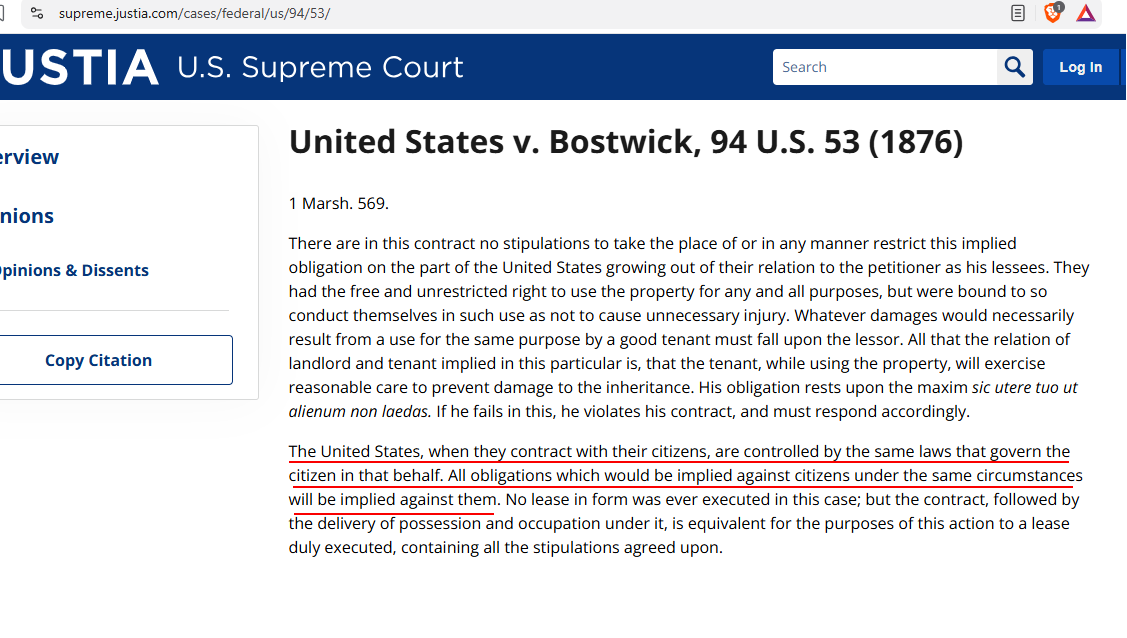
United States v. Bostwick, 94 U.S. 53 (1876)
“The United States, when they contract with their citizens, are controlled by the same laws that govern the citizen in that behalf. All obligations which would be implied against citizens under the same circumstances will be implied against them.”
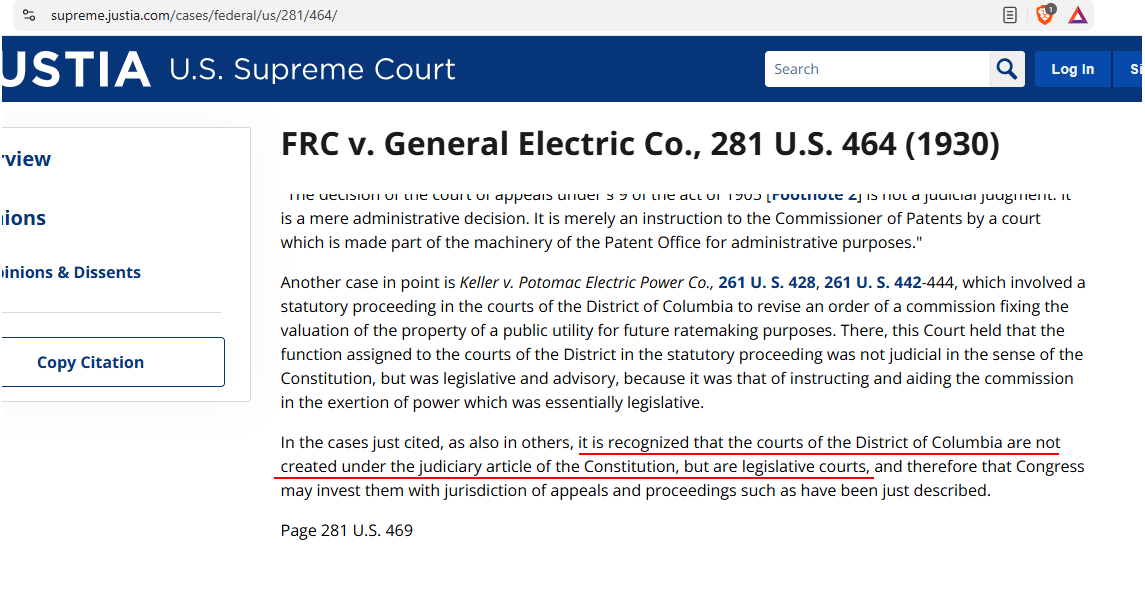
Federal Radio Commission v. General Electric Company (1930)
“In the cases just cited, as also in others, it is recognized that the courts of the District of Columbia are not created under the judiciary article of the Constitution but are legislative courts,”
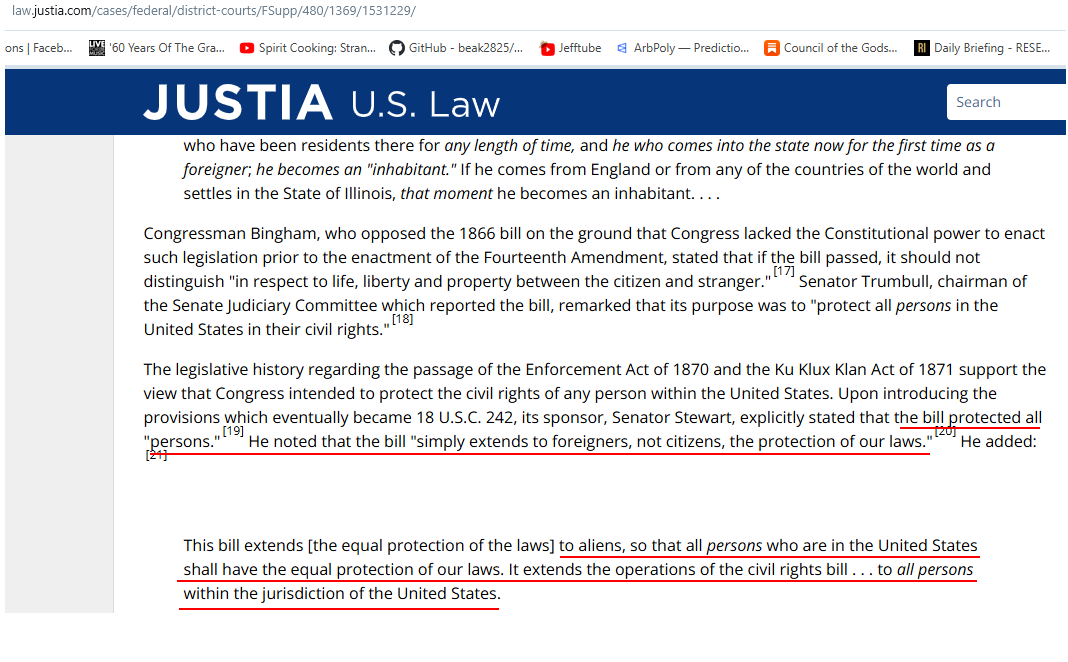
United States v. Otherson, 480 F. Supp. 1369 (S.D. Cal. 1979)
“Upon introducing the provisions which eventually became 18 U.S.C. 242, its sponsor, Senator Stewart, explicitly stated that the bill protected all “persons.”[19] He noted that the bill “simply extends to foreigners, not citizens, the protection of our laws.”[20] He added:[21] This bill extends [the equal protection of the laws] to aliens, so that all persons who are in the United States shall have the equal protection of our laws. It extends the operations of the civil rights bill . . . to all persons within the jurisdiction of the United States.”
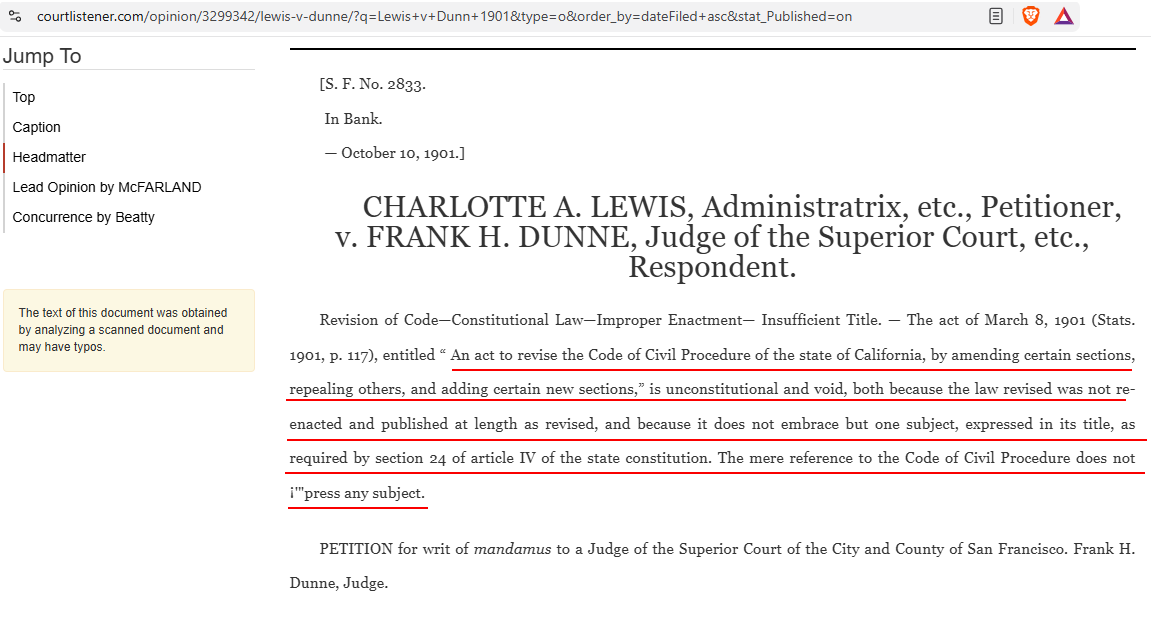
Lewis v Dunn, 134 Cal 291, (1901)
“An act to revise the Code of Civil Procedure of the state of California, by amending certain sections, repealing others, and adding certain new sections,” is unconstitutional and void, both because the law revised was not re-enacted and published at length as revised, and because it does not embrace but one subject, expressed in its title, as required by section 24 of article IV of the state constitution. The mere reference to the Code of Civil Procedure does not express any subject.
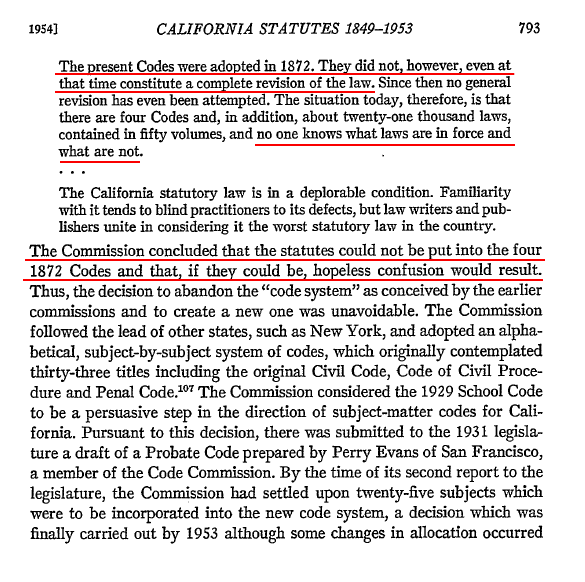
California Law Review on California Statutes 1849-1953 - 1
“The present Codes were adopted in 1872. They did not, however, even at that time, constitute a complete revision of the law. Since then no general revision has ever been attempted. The situation today, therefore, is that there are four Codes and, in addition, about twenty one thousand laws, contained in fifty volumes, and no one knows what laws are in force and what are not.”
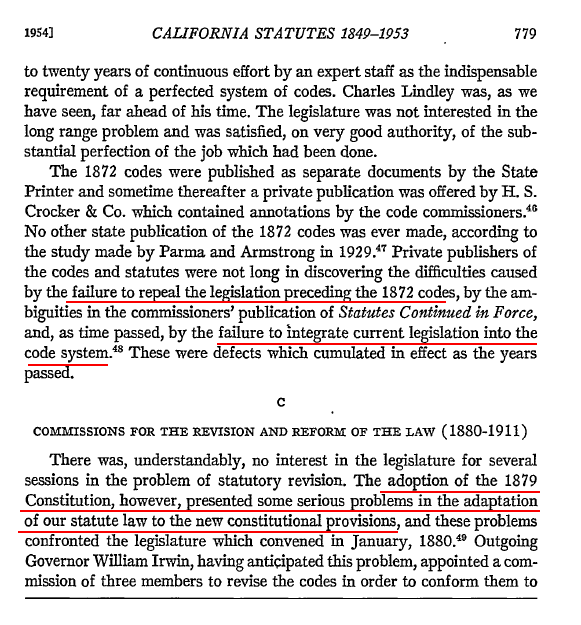
California Law Review on California Statutes 1849-1953 - 2
“failure to repeal the legislation preceding the 1872 codes, by the ambiguities in the commissioners’ publication of Statutes Continued in Force, and, as time passed, by the failure to integrate current legislation into the code system … The adoption of the 1879 Constitution, however, presented some serious problems in the adaptation of our statute law to the new constitutional provisions”
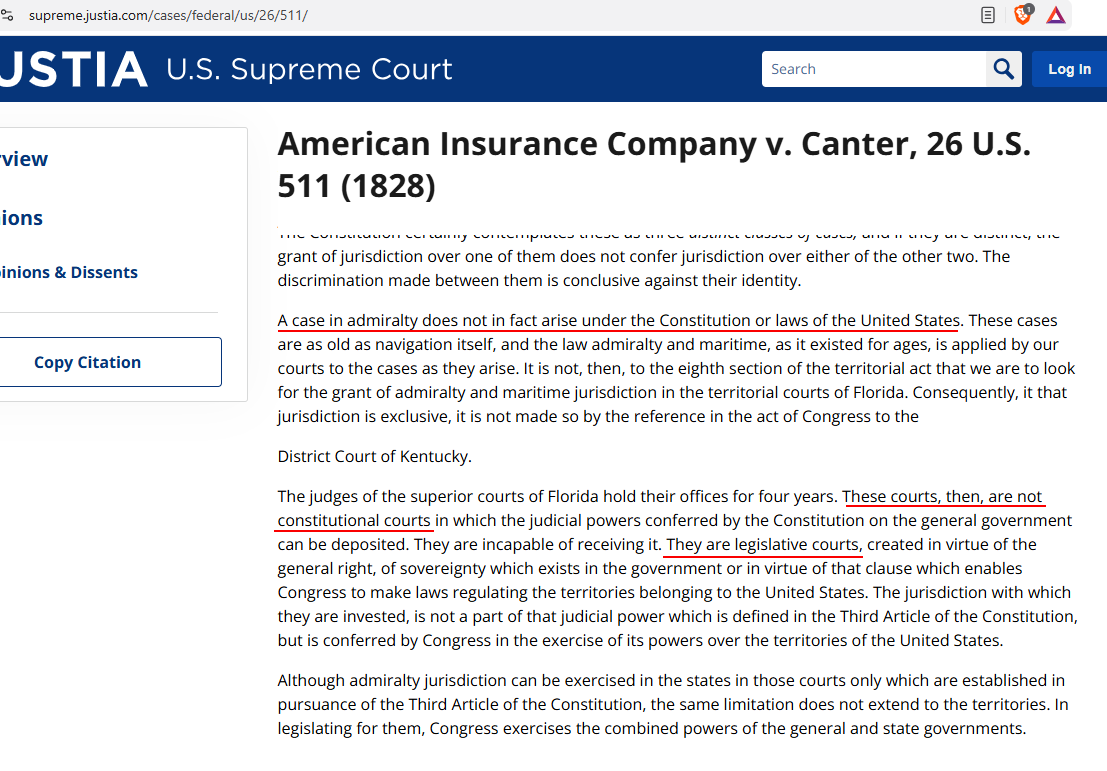
American Insurance Company v. Canter, 26 U.S. 511 (1828)
“A case in admiralty does not in fact arise under the Constitution or laws of the United States. …. These courts, then, are not constitutional courts ….. They are legislative courts”
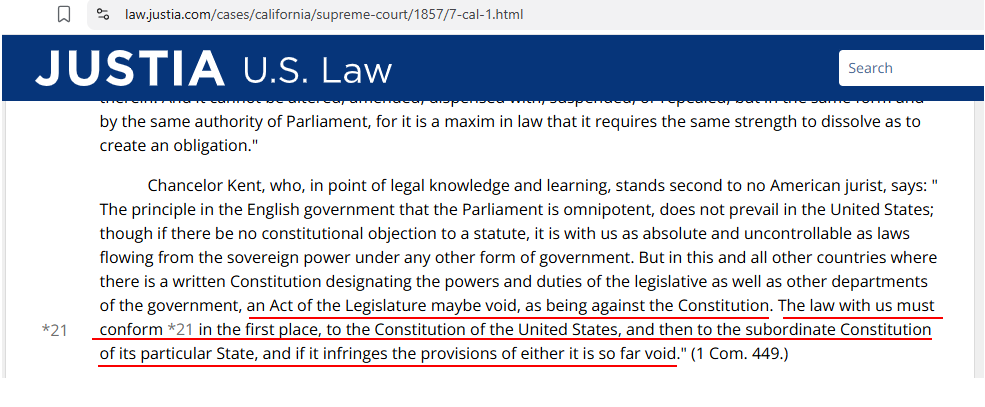
Billings v. Hall, 7 Cal. 1 (Cal. 1857)
“an act of the Legislature may be void, as being against the Constitution. The law with us must conform, in the first place, to the Constitution of the United States, and then to the subordinate Constitution of its particular State, and if it infringes the provisions of either it is so far void.”
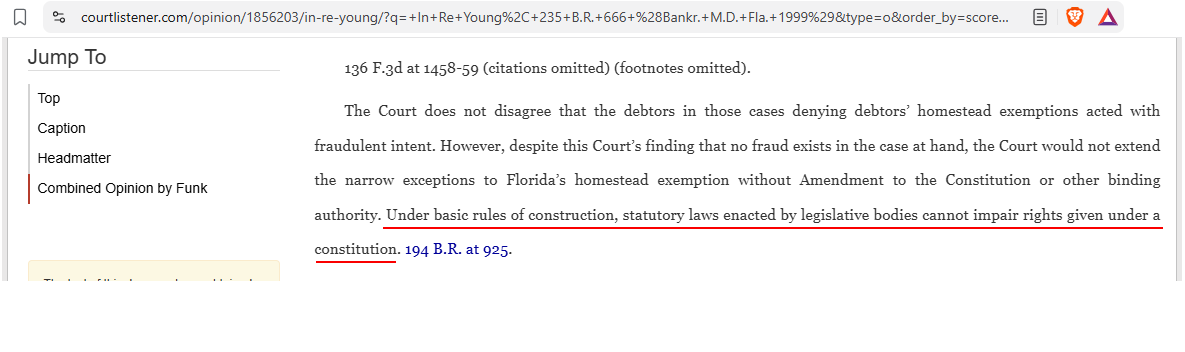
In Re Young, 235 B.R. 666 (Bankr. M.D. Fla. 1999)
“Under basic rules of construction, statutory laws enacted by legislative bodies cannot impair rights given under a constitution.”
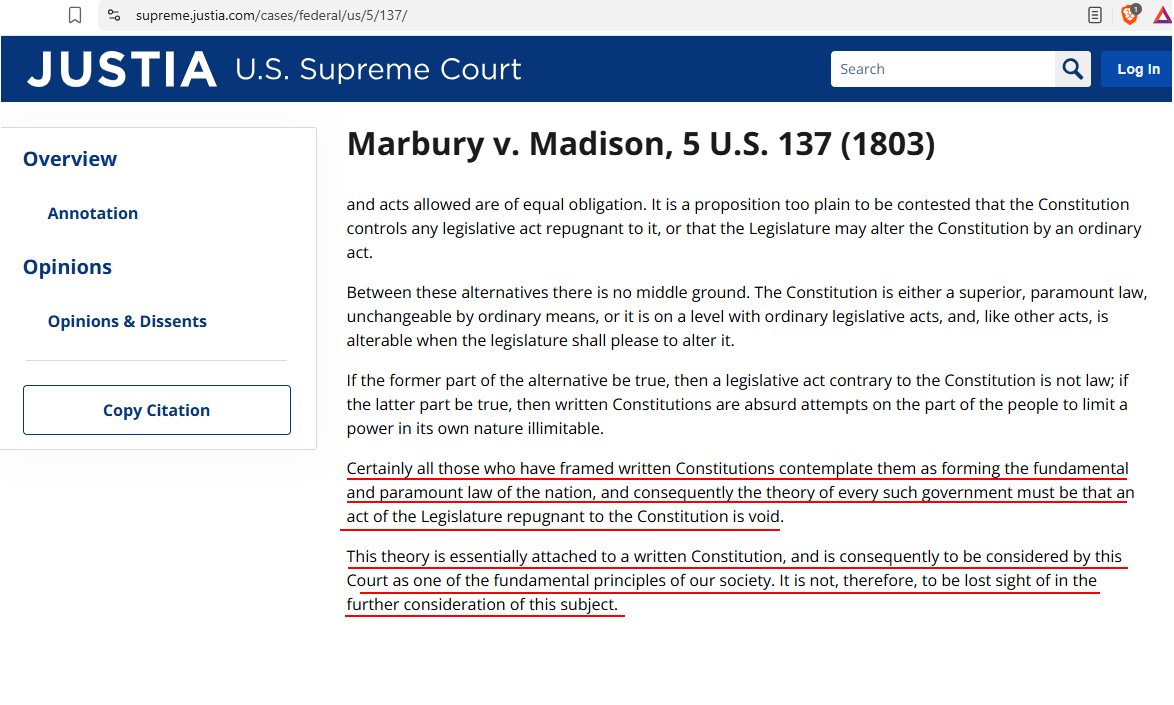
Marbury v. Madison, 5 U.S. 137, 174, 176 (1803)
“consequently the theory of every such government must be that an act of the Legislature repugnant to the Constitution is void. … This theory is essentially attached to a written Constitution, and is consequently to be considered by this Court as one of the fundamental principles of our society. It is not, therefore, to be lost sight of in the further consideration of this subject.”
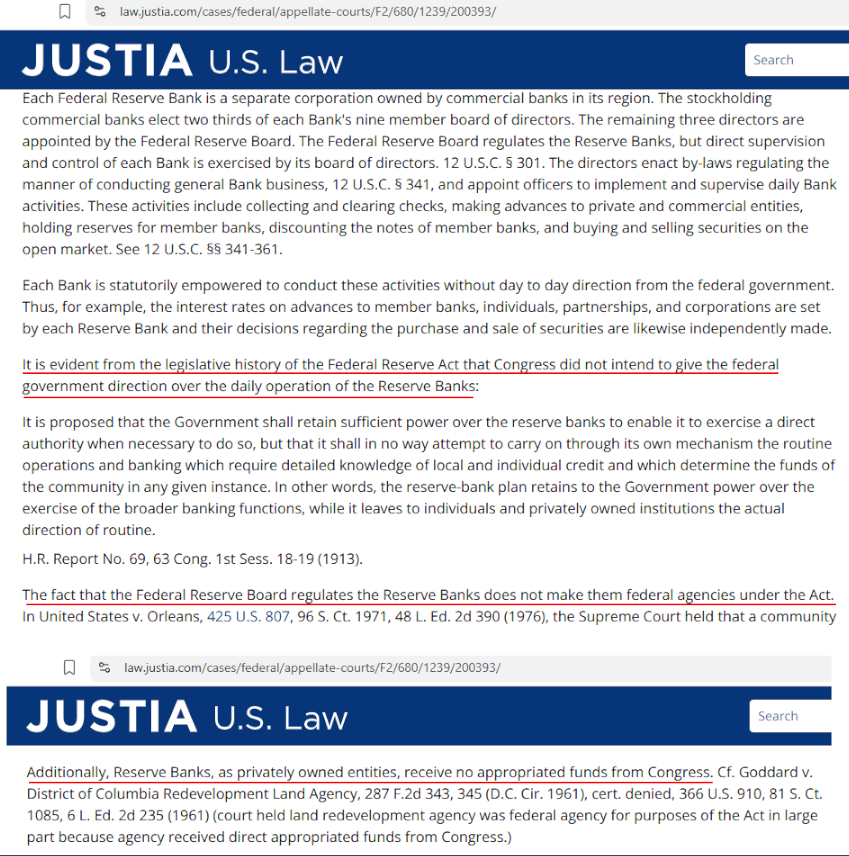
Lewis v. United States 680 F.2d 1239 (9th Cir. 1982)
“Each Federal Reserve Bank is a separate corporation owned by commercial banks in its region” ….. “t is evident from the legislative history of the Federal Reserve Act that Congress did not intend to give the federal government direction over the daily operation of the Reserve Banks.” …. “The fact that the Federal Reserve Board regulates the Reserve Banks does not make them federal agencies under the Act.” …. “Additionally, Reserve Banks, as privately owned entities, receive no appropriated funds from Congress.”
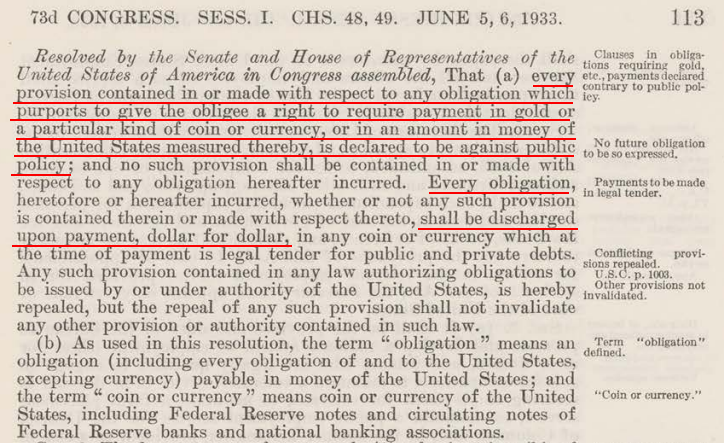
HJR-192 June 5, 1933
“That (a) every provision contained in or made with respect to any obligation which purports to give the obligee a right to require payment in gold or a particular kind of coin or currency, or in an amount in money of the United States measured thereby, is declared to be against public policy; …. Every obligation,
heretofore or hereafter incurred, …. shall be discharged upon payment, dollar for dollar”
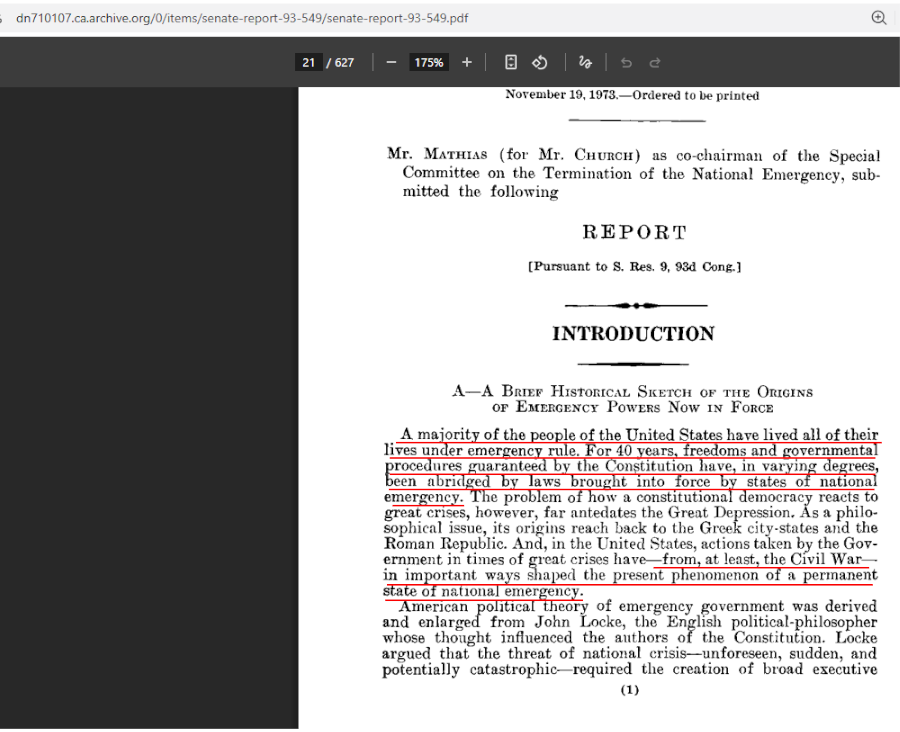
Emergency War Powers Senate Report 93-549 (1973)
“A majority of the people of the United States have lived all of their lives under emergency rule. For 40 years, freedoms and governmental procedures guaranteed by the Constitution have, in varying degrees, been abridged by laws brought into force by states of national emergency.” …. “from, at least, the Civil War- in important ways shaped the present phenomenon of a permanent state of national emergency.”
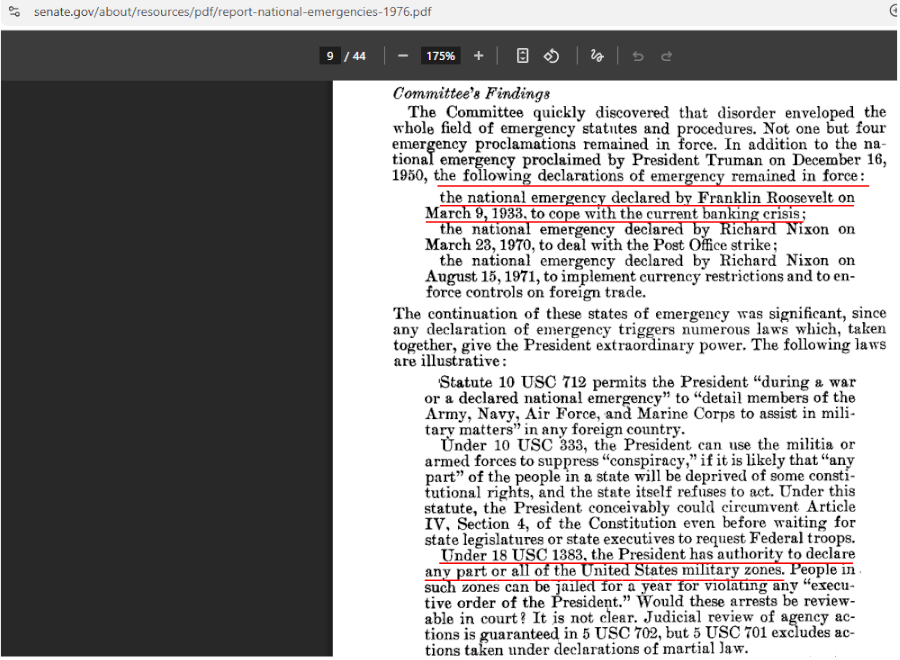
Emergency War Powers Senate Report 94-922 (1976)
“The Committee quickly discovered that disorder enveloped the whole field of emergency statutes and procedures. Not one but four emergency proclamations remained in force. In addition to the nationa emergency proclaimed by President Truman on December 16, 1950, the following declarations of emergency remained in force: the national emergency declared by Franklin Roosevelt on March 9,1933, to cope with the current banking crisis”
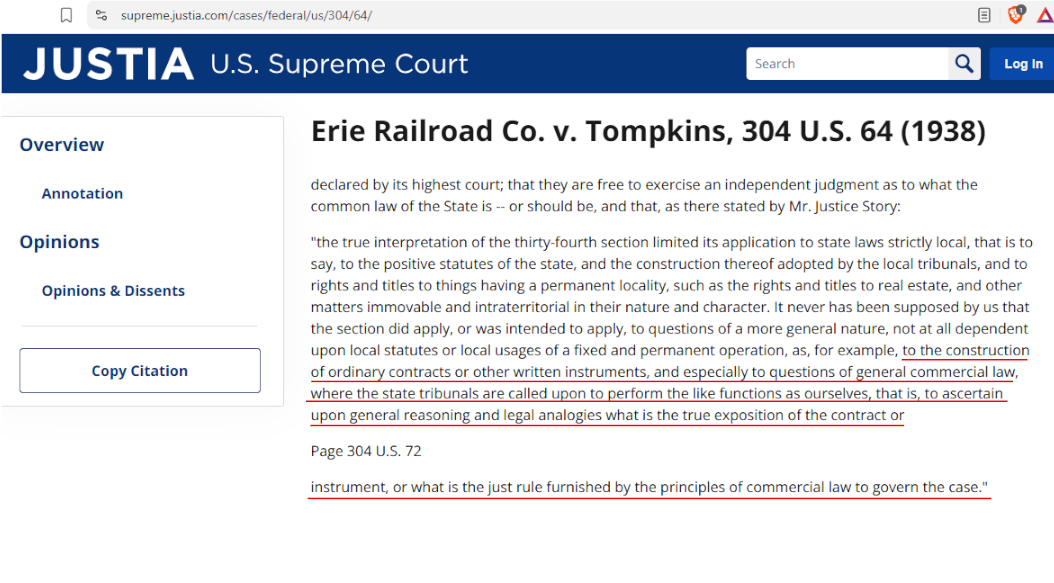
Erie Railroad Co. v. Tompkins, 304 U.S. 64 (1938) (A)
“It never has been supposed by us that the section did apply, or was intended to apply, to questions of a more general nature, not at all dependent upon local statutes or local usages of a fixed and permanent operation, as, for example, to the construction of ordinary contracts or other written instruments, and especially to questions of general commercial law, where the state tribunals are called upon to perform the like functions as ourselves, that is, to ascertain upon general reasoning and legal analogies what is the true exposition of the contract or instrument, or what is the just rule furnished by the principles of commercial law to govern the case.”
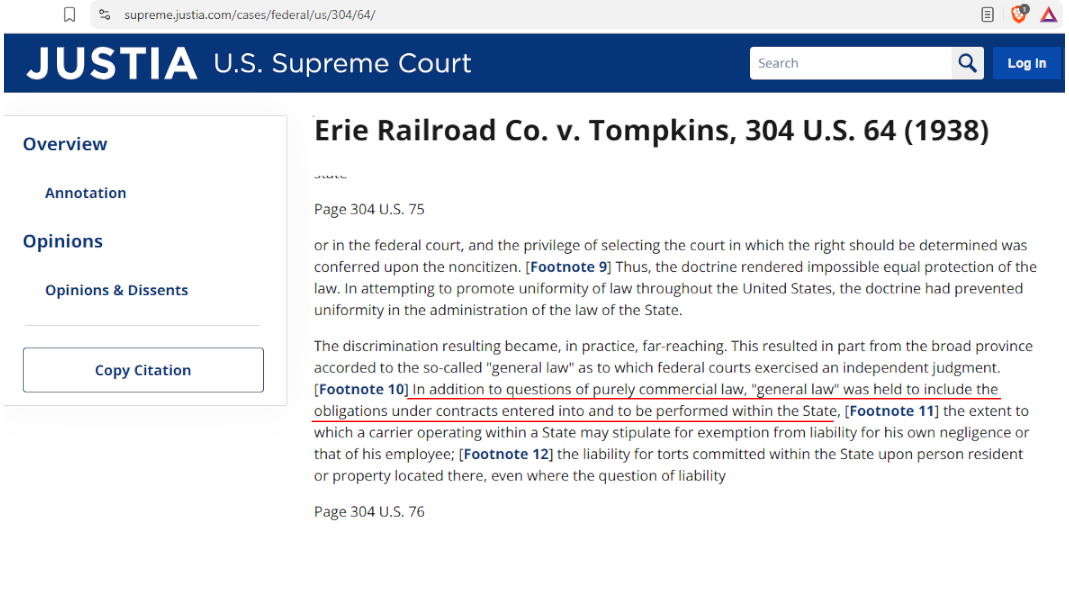
Erie Railroad Co. v. Tompkins, 304 U.S. 64 (1938) (B)
“In addition to questions of purely Commercial law, ‘general law’ was held to include the obligations under contracts entered into and to be performed within a State”
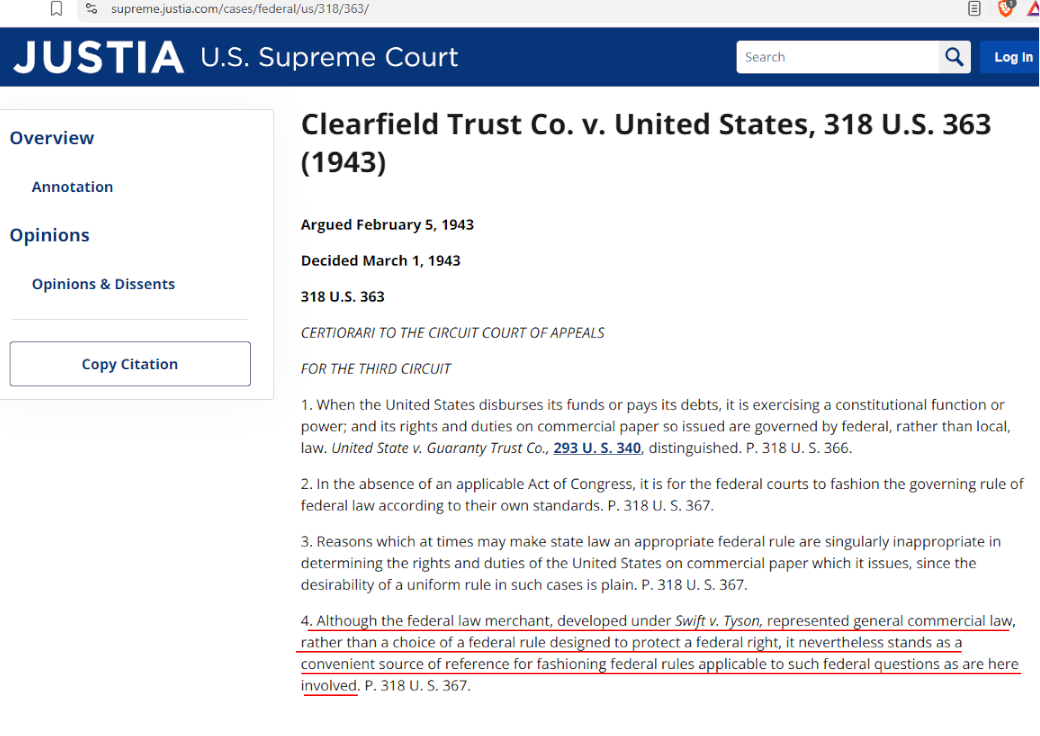
Clearfield Trust Co. v. United States, 318 U.S. 363 (1943)
“Although the federal law merchant, developed under Swift v. Tyson, represented general commercial law, rather than a choice of a federal rule designed to protect a federal right, it nevertheless stands as a convenient source of reference for fashioning federal rules applicable to such federal questions as are here involved.”
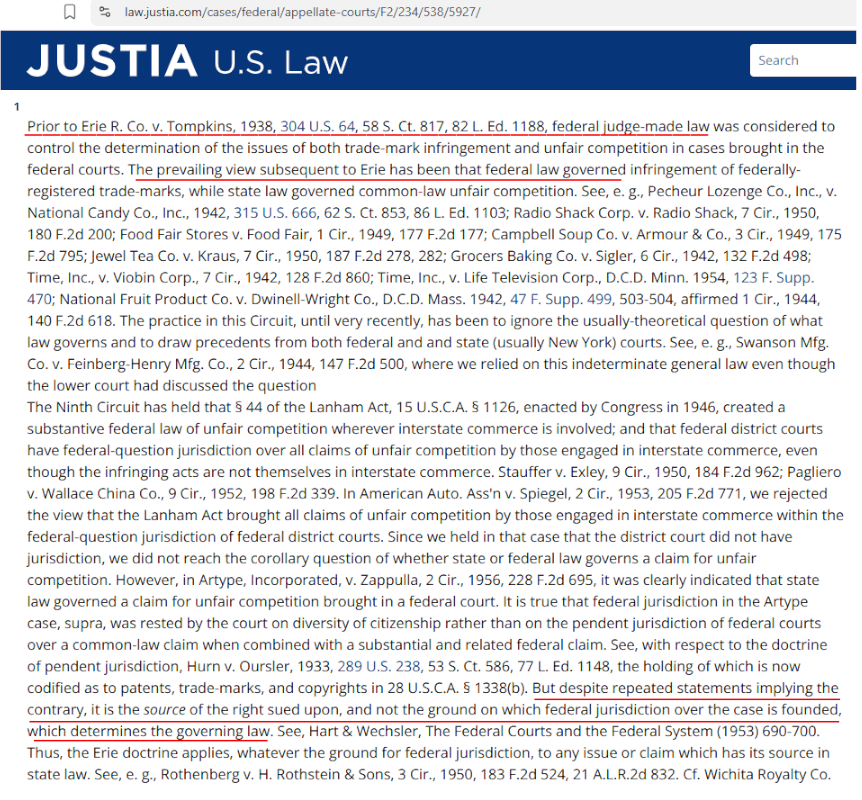
Maternally Yours v. Your Maternity Shop, Inc. (2d Cir. 1956)
“Prior to Erie R. Co. v. Tompkins, 1938, 304 U.S. 64, 58 S. Ct. 817, 82 L. Ed. 1188, federal judge-made law was considered to control the determination of the issues of both trade-mark infringement and unfair competition in cases brought in the federal courts. The prevailing view subsequent to Erie has been that federal law governed infringement of federally-registered trade-marks, while state law governed common-law unfair competition. ….. But despite repeated statements implying the contrary, it is the source of the right sued upon, and not the ground on which federal jurisdiction over the case is founded, which determines the governing law. See, Hart & Wechsler, The Federal Courts and the Federal System (1953) 690-700. Thus, the Erie doctrine applies, whatever the ground for federal jurisdiction, to any issue or claim which has its source in state law.”
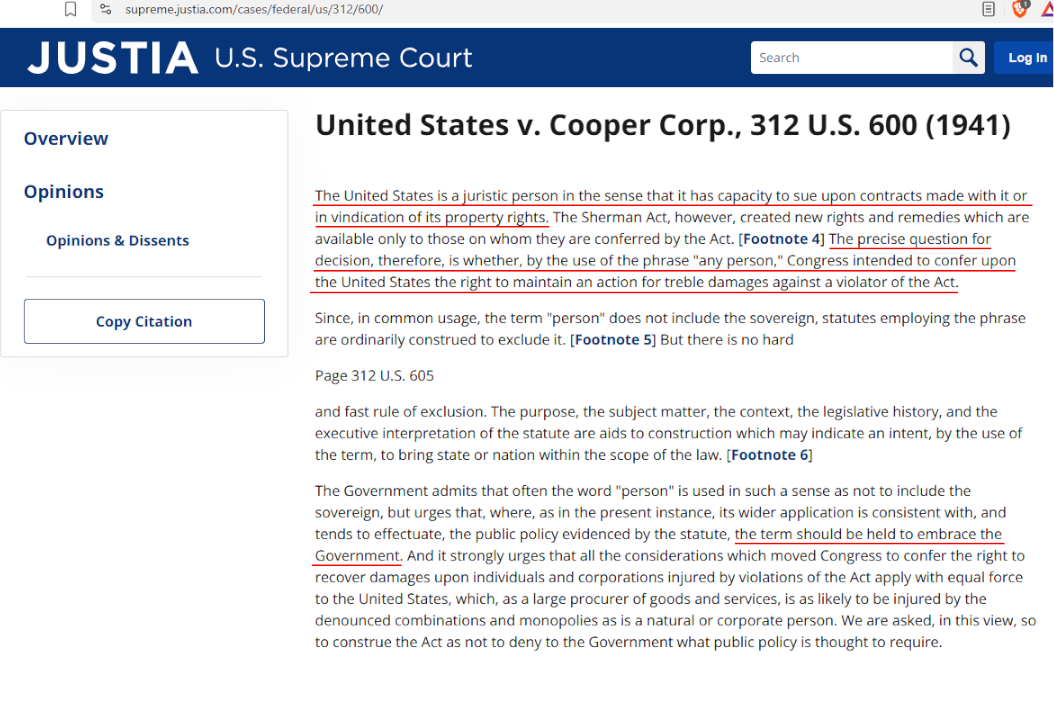
United States v. Cooper Corp., 312 U.S. 600 (1941)
“The United States is a juristic person in the sense that it has capacity to sue upon contracts made with it or in vindication of its property rights.” ….“The precise question for decision, therefore, is whether, by the use of the phrase “any person,” Congress intended to confer upon the United States the right to maintain an action for treble damages against a violator of the Act.” … “the term should be held to embrace the Government.”
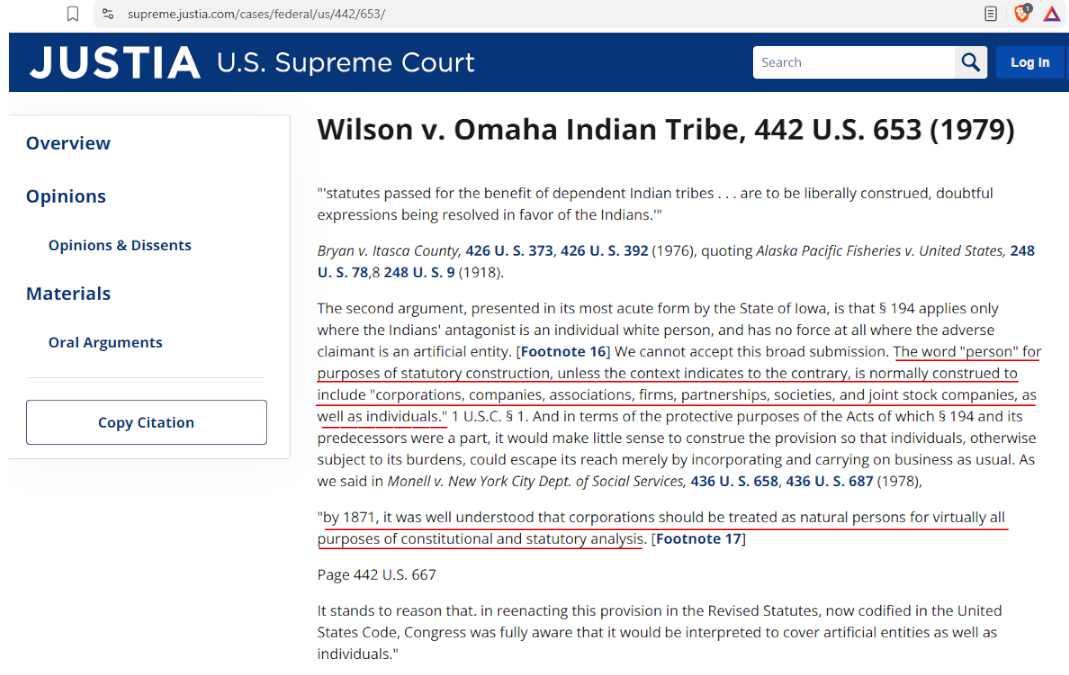
Wilson v. Omaha Indian Tribe, 442 U.S. 653 (1979)
“The word ‘person’ for purposes of statutory construction, unless the context indicates to the contrary, is normally construed to include ‘corporations, companies, associations, firms, partnerships, societies, and joint stock companies, as well as individuals.'” …. ” ‘by 1871, it was well understood that corporations should be treated as natural persons for virtually all purposes of constitutional and statutory analysis.”